 Inflatable Kayak for 2 People with Detachable Canopy, Reinforced Paddles 2-person
 $99.97 View on Amazon
Sizing specs: Inflatable Kayak for 2 People with... Calculator
Quick answerDivide your total load by 0.7. A 200 lb paddler with 25 lb of day gear carries 225 lb, so the kayak should be rated for at least 325 lb. Loading past 70 percent of the maximum makes a kayak sit low, track poorly and take on water in chop.
Cards re-sort as you change the inputs: the ones that meet your numbers move to the front. Check each listing's rated capacity and dimensions before buying.
Inflatable Kayak for 2 People with Detachable Canopy, Reinforced Paddles 2-person  INTEX Explorer Kayak 2-Person Portable Set w/Paddles & Pump, 2-Pack 10'4" / 400 lb max / 2-person
  Aqua Marina Tomahawk Air-K Inflatable Touring Kayak, 1 Person, 12 Ft 4 In 12'4" / 1-person
 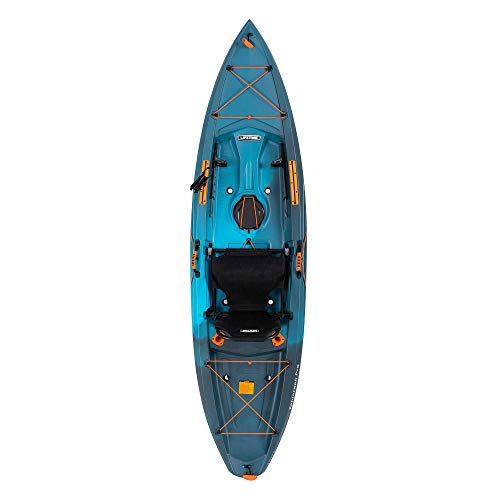 Lifetime Tamarack Pro 103 Sit-On-Top Kayak, Lightning Fusion, 10 ft. 3 in. 10'
  Perception Kayaks - 13.5 Tandem Kayak - Sit on Top - Large Rear Storage with Tie Downs - 13.5 ft - Deja Vu 13'6" / 500 lb max / 2-person
  Oru Haven Foldable Kayak | for 1 or 2 People - Stable, Durable, Lightweight - Lake and River Kayaks - Beginner, Intermediate - Size (Unfolded): 16'1" x 33", Weight: 41 Lbs, Black 16'1" / 2-person
 total load = paddler + passenger + gear | required rated capacity = total load / 0.70 | load share = total load / boat rating
The maker's figure is the most the hull can float, not what it paddles well with. Recreational paddlers should stay at or below 70 percent. At 70 to 85 percent the boat still floats but gets sluggish; past 85 percent it is unsafe in wind or waves.
A kayak's weight capacity is the maximum load the hull can float, published by the maker. It is not the load the boat paddles well with. Recreational outfitters use a 70 percent rule: keep the total of paddler, passenger and gear at or below 70 percent of the rating, and the boat sits at its designed waterline with enough freeboard for chop and boat wakes.
Enter the heaviest paddler, any passenger (a second adult, a child or a dog) and your gear. The calculator returns the rating to shop for (load divided by 0.7), the absolute floor at 85 percent, and the kind of boat that usually carries that rating. If you already own a boat, enter its rating to see how loaded it will be.
| Load as % of rating | How the boat behaves |
|---|---|
| Under 70% | Designed waterline, tracks and turns as intended |
| 70 to 85% | Slower, less freeboard, fine on calm water |
| 85 to 100% | Low in the water, wakes come aboard, calm water close to shore only |
| Over 100% | Unsafe; may not float the load |
| Scenario | Result | Total load | Comfortable ceiling (70%) |
|---|---|---|---|
| Solo, 160 lb, day trip | 255 lb or more | 175 lb | 255 lb rating |
| Solo, 230 lb, day trip | 360 lb or more | 250 lb | 360 lb rating |
| Adult 190 lb + child 45 lb | 360 lb or more | 250 lb | 360 lb rating |
| Adult 200 lb + dog 70 lb | 410 lb or more | 285 lb | 410 lb rating |
| Two adults, 180 + 150 lb | 510 lb or more | 355 lb | 510 lb rating |
| Two adults in an Intex K2 (400 lb) | 510 lb or more | 355 lb | 510 lb rating |
Add up everyone and everything in the boat and divide by 0.7. A 200 lb paddler with 25 lb of gear needs a kayak rated for about 325 lb. Many solo 10 foot sit-in kayaks are rated around 275 lb, which is too little for that paddler once gear is aboard.
Yes. The rating is the total load: paddler, passengers, gear, water and anything strapped to the deck. It does not include the weight of the kayak itself.
It is rated 400 lb, so two adults totaling about 255 lb plus 25 lb of gear sit right at the 70 percent line. Heavier pairs can still paddle it on calm water but it will ride low; for two average adults a 500 lb or higher rated tandem paddles better.
On a calm pond close to shore it will float you, but it will be slow, hard to turn and quick to take on water from any wake. Leave at least a 15 percent margin, and ideally 30 percent, especially with a child or dog who may shift weight suddenly.
On the water: Wear a properly fitted, USCG-approved life jacket every time, dress for the water temperature rather than the air, and check your state and local paddling regulations before you launch.
This is researched general information, not professional advice. Sizing figures are starting points: confirm against the maker's own sizing chart and the capacity printed on the boat or board.