 DORSAL Surfboard Tie Down Straps - 15 Ft Roof Rack for Surf, Kayak, SUP, Black 2 Pack
 $18.95 View on Amazon
Calculator
Quick answerMost cars allow 100 to 165 lb on the roof while driving (the dynamic limit in the owner's manual). Two 50 lb recreational kayaks, two J-cradles at 10 lb each and 15 lb of crossbars total 135 lb, which is over a 110 lb limit.
Bow and stern tie-downs are recommended for any kayak over 12 feet or any highway trip.
Cards re-sort as you change the inputs: the ones that meet your numbers move to the front. Check each listing's rated capacity and dimensions before buying.
DORSAL Surfboard Tie Down Straps - 15 Ft Roof Rack for Surf, Kayak, SUP, Black 2 Pack 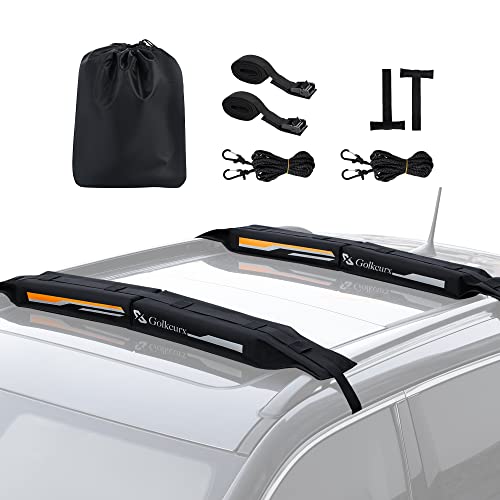 Golkcurx Universal Soft Roof Rack Pads for Kayak (Black)
  Amazon Basics Cross Rail Roof Rack, 52 inches, Fits up to 46" Spans between Raised Side Rails with Gap, Pack of 2, Black/Silver 165 lb max
  Thule Hull-a-Port Pro, 75lb Load Capacity, Fits Most Roof Racks
  Yakima JayLow J-Cradle Rooftop Kayak Mount for Crossbars, 1 or 2 Boats
  Thule Hull-a-Port Aero Rooftop Kayak Rack, Carries 1 Kayak, Foldable Design
 total = boats x boat weight + carriers x carrier weight + crossbar weight | limit = lower of car dynamic limit and rack rating
The static limit (parked, for a roof tent) is much higher and does not apply to driving. Use the dynamic figure. When unsure, 100 lb is a conservative sedan default.
Every car has a dynamic roof load, the most weight the roof and rails may carry while driving, printed in the owner's manual. It is usually 100 to 165 lb and covers everything up there: boats, carriers and crossbars. Your rack or crossbars carry their own rating, and the lower of the two numbers is your real limit.
Inflatable kayaks and boards dodge the whole problem: they pack into the trunk. If you do car-top, two boats on J-cradles is the practical maximum on most crossbars, and a stacker lets you carry three or four boats on edge.
| Scenario | Result | Boats | Carriers |
|---|---|---|---|
| One 50 lb kayak, J-cradle | 75 lb of 165 lb | 1 x 50 = 50 lb | 10 lb |
| Two 50 lb kayaks, J-cradles | 135 lb of 165 lb | 2 x 50 = 100 lb | 20 lb |
| Two kayaks, sedan 110 lb limit | Over the limit: Total 135 lb is 25 lb over the 110 lb limit (123%). | ||
| Two hard SUPs on pads | 59 lb of 165 lb | 2 x 28 = 56 lb | 3 lb |
| Four kayaks, stacker | 199 lb of 220 lb | 4 x 45 = 180 lb | 4 lb |
Check the owner's manual for the dynamic roof load, typically 100 to 165 lb for cars and small SUVs. It includes the rack itself. The much higher static rating only applies when parked, for example with a rooftop tent.
No. Soft foam pads with straps that run through the door openings carry one kayak on a bare roof for short, slow trips. For highway speeds and regular use, crossbars plus J-cradles or saddles are safer. Or choose an inflatable, which needs no rack.
Usually yes: two 50 lb kayaks plus two J-cradles and crossbars total about 135 lb, which fits a 150 to 165 lb roof limit but not a 110 lb one. Stack them on edge with a stacker bar if the bars are short.
On the water: Wear a properly fitted, USCG-approved life jacket every time, dress for the water temperature rather than the air, and check your state and local paddling regulations before you launch.
This is researched general information, not professional advice. Sizing figures are starting points: confirm against the maker's own sizing chart and the capacity printed on the boat or board.