 DORSAL Surfboard Tie Down Straps - 15 Ft Roof Rack for Surf, Kayak, SUP, Black 2 Pack
 $18.95 View on Amazon
Guides
Quick answerYou don't need a roof rack to transport most kayaks: a set of soft roof pads works on a bare roof with no rails, though a J-bar carrier like the Forluck J-Bar Carrier is the sturdier choice once you have roof rails or crossbars to mount it to.
Transporting a kayak comes down to four real options: soft pads that strap to a bare roof, a J-bar carrier that mounts to existing rails or crossbars, a hitch-mounted rack that skips the roof entirely, or a beach cart that rolls the boat from the car to the water. Which one you need depends mostly on whether your vehicle already has roof rails, not on how far you're driving.
No, not necessarily. If your car has no factory roof rails or crossbars, a set of soft foam pads that strap directly across the bare roof, combined with tie-down straps to the door frames or a hood and trunk loop kit, safely carries most single kayaks under about 130 lb. If you do have roof rails or aftermarket crossbars already installed, a J-bar carrier is the sturdier, more secure upgrade and lets you angle the kayak on its side to fit a second boat or gear beside it.
Each method trades off cost, capacity, and what your vehicle needs to already have.
| Method | Requires | Typical capacity | Best for |
|---|---|---|---|
| Soft roof rack pads | Bare roof, no rails needed | ~130 lb | No roof rails, occasional trips |
| J-bar roof rack | Existing roof rails or crossbars | ~150 lb | Regular trips, angled two-boat carrying |
| Hitch mount rack | A trailer hitch receiver | ~150 lb | SUVs and trucks, avoiding lifting to the roof |
| Kayak cart | A kayak with carry handles | ~280 lb | Rolling the boat from the car to the water |
A hitch mount rack is worth a look if lifting a kayak over your head to a roof feels like the real obstacle, since it holds the boat vertically at bumper height instead. A cart solves a different problem entirely, getting a loaded kayak across a parking lot or trail to the launch point without carrying it, and pairs well with any of the three carrying methods above.
Check your owner's manual before you assume the roof can take it. Most passenger vehicles list a dynamic roof load, meaning weight while driving, somewhere between 100 and 165 lb total, which has to cover the rack hardware itself plus the kayak. A pair of J-cradles adds roughly 10 lb each before the boat even goes on, so a 150 lb dynamic load rating leaves less headroom than it first appears once you've mounted J-bar hardware rated to carry 150 lb of kayak on top of that.
Yes, every time, regardless of which rack style you use. The rack cradles and holds the kayak's shape, but tie-down straps over the hull secure it to the rack itself, and separate bow and stern lines running to tow hooks or bumper loops stop the kayak from shifting forward, backward, or lifting at highway speed. Skipping the bow and stern lines is one of the most common causes of a kayak coming loose on the highway, even with a rack rated well above the boat's weight.
An even spread across the price range, cheapest to premium. Prices at last check.
DORSAL Surfboard Tie Down Straps - 15 Ft Roof Rack for Surf, Kayak, SUP, Black 2 Pack 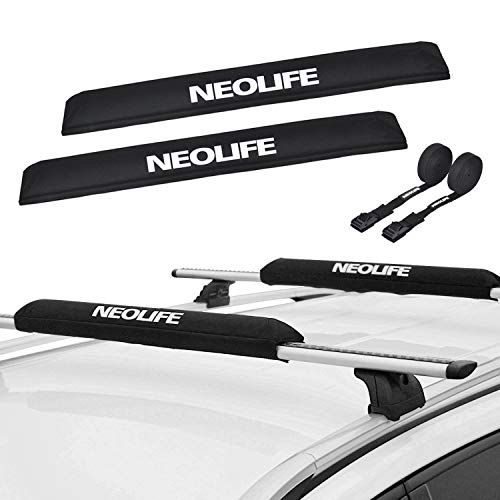 WONITAGO Soft Roof Rack Pads for Surfboard, SUP Paddleboard and Snowboard
  2 Pairs Heavy Duty Kayak Roof Rack,J-Bar Carrier Holder,Set of 4 150 lb max
  PENSUN RV Hitch Mount Kayak Rack, 2" Hitch Mount Vertical Kayak Carrier, Height Adjustable Heavy Duty Steel Kayak Holder Holds Up to 150LBS for RV, Truck, SUV, with Soft Padding & Ratchet Straps 150 lb max
  Thule Portage Canoe Carrier, One Size 100 lb max
  Thule Hull-a-Port Aero Rooftop Kayak Rack, Carries 1 Kayak, Foldable Design
 Not always. Soft foam pads strapped to a bare roof work for most single kayaks under about 130 lb with no rails or crossbars required. If your car already has roof rails, a J-bar carrier is the more secure option and lets you angle the boat to carry two kayaks at once.
Use soft roof pads that strap across the bare roof, then run tie-down straps through the open door frames to secure the pads, plus separate bow and stern lines to the front and rear of the vehicle. This works for most kayaks under roughly 130 lb without any rails or crossbars.
A J-bar is a curved cradle that mounts to roof rails or crossbars and holds the kayak on its side rather than flat. Angling the boat this way uses less roof width, which is why J-bars are the standard choice for carrying two kayaks on one vehicle.
It depends on your vehicle and how you load. A hitch mount rack holds the kayak vertically at bumper height, which avoids lifting the boat overhead, but it does add length behind the vehicle and needs a hitch receiver installed. A roof rack keeps overall vehicle length unchanged but requires lifting the kayak up.
A cart solves a different problem than a rack. It's for rolling the kayak from your parking spot to the actual water's edge, which matters most at boat ramps, beaches, or trailheads with any real distance to cover. Many paddlers use a rack for driving and a cart for the last stretch on foot.
On the water: Wear a properly fitted, USCG-approved life jacket every time, dress for the water temperature rather than the air, and check your state and local paddling regulations before you launch.
This is researched general information, not professional advice. Sizing figures are starting points: confirm against the maker's own sizing chart and the capacity printed on the boat or board.