 Sun Ninja Hand Pump for Paddle Board, Inflatable Hammock and Floating Chair
 $18.89 View on Amazon
Guides
Quick answerMost inflatable paddle boards need 12 to 15 PSI, which takes about 425 strokes and roughly 9 minutes with a manual pump, or a few minutes with an electric pump such as the OutdoorMaster Shark 2 that inflates to pressure automatically.
Inflating a paddle board is straightforward once you know the target: 12 to 15 PSI for a typical all-around inflatable, reached with either a manual double-action pump in about 9 minutes or an electric pump in a few minutes hands-free. The part paddlers get wrong more often is what happens after: a board pumped to full pressure and then left fully inflated in direct, hot sun can climb well past its rated PSI as the trapped air heats up.
Check the valve or a sticker near it for the manufacturer's rated pressure, since it varies by board, but most all-around inflatable SUPs are built for 12 to 15 PSI, with some higher-performance and touring boards rated up to 20 to 26 PSI for extra rigidity. Inflating under the rated PSI leaves the board soft and flexy underfoot; over-inflating past the rated maximum stresses the seams for no real benefit in stiffness.
For reference, a common 10'6" x 33" x 6" board holds about 295 liters of air, and reaching 15 PSI with a standard manual pump takes roughly 425 strokes, about 9 minutes of steady pumping. That effort is why many paddlers who inflate regularly move to a double-action hand pump, which moves air on both strokes instead of one, or to an electric pump that does the work automatically.
| Pump type | Typical time to 15 PSI | Effort | Example |
|---|---|---|---|
| Single-action hand pump | ~9 to 12 minutes | High, full stroke each way | AQUAGLIDE Universal Hand Pump |
| Double-action hand pump | ~6 to 8 minutes | Moderate, air moves both strokes | THURSO SURF Paddle Board Pump |
| Electric pump | ~3 to 5 minutes | Minimal, mostly hands-free | OutdoorMaster Shark 2 |
| High-output electric pump | Under 4 minutes | Minimal | OutdoorMaster Shark 3 |
Most inflatable boards use a twist-lock valve: turn the pin down and lock it before you start pumping so air can only flow in, then thread the pump hose on securely so it doesn't pop off under pressure. Once you reach your target PSI, disconnect the hose quickly and press the valve cap down firmly to seal it. To deflate later, twist the same pin to unlock it, which releases air quickly instead of having to press and hold.
Trapped air expands as it warms, and a fully inflated paddle board left on hot pavement or in direct sun can gain roughly 1 PSI for every 25 degrees the air inside heats up. A board pumped to 15 PSI in the cool morning can climb toward 18 or 19 PSI by midday sun, which stresses the seams over time even if the board doesn't visibly bulge. Let a small amount of air out before leaving a board fully inflated in the sun for hours, or store it partially deflated and top it off right before you launch.
An even spread across the price range, cheapest to premium. Prices at last check.
Sun Ninja Hand Pump for Paddle Board, Inflatable Hammock and Floating Chair  BAVIZZN Paddle Board Pump, Electric SUP Pump for Paddle Board Inflatables (Orange) 22 PSI
  Aoiiefe Paddle Board Pump, 13500mAh Rechargeable 20PSI Portable Paddle Board Electric Pump, USB-C SUP Air Pump, Intelligent Dual Stage Inflation Deflation, Auto-Off 20 PSI
 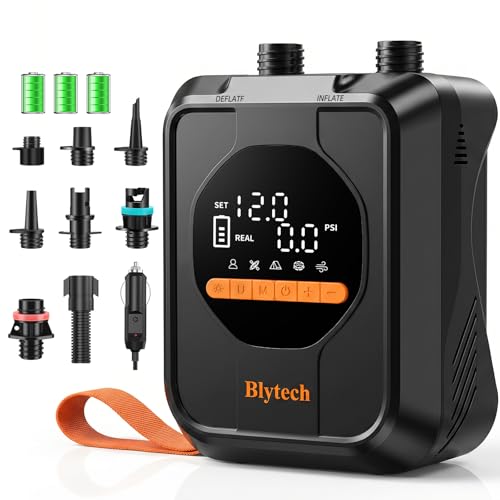 Electric Paddle Board Pump, Portable 20PSI SUP Air Pump with 13,500mAh Rechargeable Battery, Fast Inflation/Deflation, 7 Nozzles for Kayaks, Boats, Tents, and Inflatables (Black) 20 PSI
  OutdoorMaster Shark 2 High Pressure SUP Pump, Electric Air Pump 20 PSI 20 PSI
  OutdoorMaster Shark 3 Mini 74Wh Portable Paddle Board Pump Electric 15 PSI
 Lock the valve pin down, attach the pump hose securely, and pump to the board's rated PSI, typically 12 to 15 for an all-around board. A manual double-action pump takes about 6 to 9 minutes; an electric pump does it in a few minutes with little effort.
Check the sticker near the valve for the exact rating, but most all-around boards are built for 12 to 15 PSI. Touring and performance-oriented boards sometimes run higher, up to 20 to 26 PSI, for extra rigidity at speed.
Around 9 minutes with a standard single-action pump to reach 15 PSI on a typical board, roughly 425 strokes. A double-action pump, which moves air on both the push and pull, cuts that closer to 6 to 8 minutes for the same board.
Not strictly, a hand pump works fine, but an electric pump removes nearly all the physical effort and cuts inflation time to a few minutes, which matters if you're setting up solo, inflating often, or paddling with kids who lose patience during a long hand-pump session.
Trapped air expands as it heats, gaining roughly 1 PSI for every 25 degrees of temperature rise. A board pumped to its rated PSI in the morning and left fully inflated in direct sun can climb several PSI over its rated maximum by afternoon, which is hard on the seams over repeated use.
Anything noticeably under the manufacturer's rated pressure, usually below about 10 to 12 PSI for an all-around board. An under-inflated board flexes visibly underfoot, feels sluggish to paddle, and wastes energy compared to reaching the full rated PSI.
On the water: Wear a properly fitted, USCG-approved life jacket every time, dress for the water temperature rather than the air, and check your state and local paddling regulations before you launch.
This is researched general information, not professional advice. Sizing figures are starting points: confirm against the maker's own sizing chart and the capacity printed on the boat or board.